Showing posts with label reviews. Show all posts

Tuesday, 27 November 2007

300: The Board Game


It was over quickly, and I enjoyed it ... sort of.

A gamer friend once told me, " Being an out of the closet Ameritrash fan means never having to answer the question 'What were you thinking when you bought that game?'" I'm going to answer the question anyway. It has Spartans. Other than that, my expectations were not particularly high. Reading between the lines of the description, I figured that it was a tactical game with a high luck factor, that could be played by two players in under an hour. In other words, about 45 minutes of chucking dice and quoting the movie in deep theatrical voices. Not much to ask. 300: The Board Game simultaneously exceeded expectations and disappointed.

Andrew Parks has done an exceptional job of creating a world in which players can immerse themselves. There are many well thought out touches that bring this game to life. I have a minor quibble with the legibility of the counters, due primarily to the use of movie stills, rather than icons to indicate unit type. However, this choice is understandable and excusable. The one thing that really prevents 300: The Board Game from being a really great, trashy, beat the crap out of your opponent game, is the use of an outmoded, arithmetic heavy battle resolution system. With a sleeker battle resolution system, such as the ones employed for Memoir '44, Nexus Ops or Monster Mash I, 300: The Board Game could have been that elusive, fast, light, exciting, 30 minute, two player game that would have saved me from another round of dull Euro fillers.

Out of the box, the game looks tasty. I almost ripped the board upon removing it. The board fills the box right to the very edge. Probing with my fingers, I found the fold and pulled. The board lurched. Much to my surprise, I had only grasped half the board's six panels. The other half swung free. I quickly lay the board down to prevent ripping it. The board was huge. Size does matter. I love the epic proportions, and the sense of place the map conveys.


The board is larger than it needed to be for a two player, column battle. Essentially, only the 6 Coastal Plain and the 6 Hot Gates spaces are necessary for game play. The rest of the board is there for thematic impact and convenience. The board is well thought out, providing everything needed to play, plus a nice clear space in the middle for rolling dice. There is a glory point track around the outer edge for keeping score. Two player aids, the Round Order and Battle Chart are printed on the upper corner. Player aids on the board are always a plus. The Persian and Spartan Camp spaces hold reinforcement tokens, so no need to worry about piles of tokens in front of players getting knocked off the table. The game lasts for 6 rounds. However, rather than having a generic turn marker, Ephialtes, the hunchback, moves one space along the goat path at the end of each round. This nice thematic touch not only keeps players in the world of the game, but also makes it easy to remember to move the marker (remember, we are the people who forget to move cars, so remembering to move a turn counter is a challenge). The only thing that I don't like about the board is the "300" written across the middle. It's like "Who the hell tagged the cliffs?" [insert lame Vandals joke here]


There are two decks of battle cards. One for the Persians, and one for the Spartans. The cards are printed on the thinest card stock ever. I think I have received greeting cards printed on thicker paper. I guess they blew the budget on the board. The cards are battle or movement modifiers. They are pretty typical - add to your attack, add to your defense, cancel the effect of your opponent's card, cancel wounds, immediately kill off some of your opponents units, etc. Most have some criteria that must be met to be used, such as a specific unit or leader must be in the battle. Each card also has a still from the movie and a quote. The rules actually state that you must read the quote aloud when playing the card, although it does not stipulate that you must read it in a deep theatrical voice. So points for providing us with the quotes, and points for pictures of hot Spartans.

The Spartans and Persians units are cardboard counters. They are about the size of a quarter and are round, and thick, and glossy. They aren't minis, but they do feel good in your hand, and there's a certain tactile satisfaction when sliding them around on the board. The Persians also get two war beast counters which are about the size of a half dollar. This sizing is, like the board, well thought out. For stacking and attack limits, each war beast is equal to three regular units. The larger size token takes up about as much room on a space as three regular sized counters. This makes it easy to not screw up the stacking limit. Another nice touch is that Xerxes, the God King of the Persians, is worth 20 points to the Spartans if killed. Dilios, the storyteller, will subtract 10 points from the Spartans score if killed (he's the only Spartan with a glory point number). This provides incentive to the respective players to have these two characters survive the battle.


Each counter has a still from the movie, as well as unit type, an attack number, and a defense number printed on them. The Persian units also have a glory point number. One side has the starting stats, with a blue boarder for the Spartan units and a yellow border on the Persian units. The flip side has the wounded stats, and is bordered in red for both the Persians and the Spartans. Here is where the design stumbles a bit. If you are sitting on one side of this huge board, looking out over your army at about a 45 degree angle, you know what you see? Yellow or Blue ringed counters with a big blur in the middle, reflecting light off their glossy pictures. You have to stand up, and bend over, with your face perpendicular to, and no more than a foot above the counters, just to distinguish one unit from another. Once a bunch of units are wounded, you can't even tell which counters are yours. Don't even think about playing this game with someone over 40. They'll be hanging four inches above the board, whipping their glasses on and off and swearing. You'll be like, "Get your fat head out of my way, I can't see my dudes." After a couple of beers, forget about it. You'll both be leaning over, and smacking your heads together, and there will be real blood on the board. Okay, that's an exaggeration. We didn't bleed, but it hurt like hell. After that, we used glass blobs to mark our units so we could tell what was what with out injuring ourselves. Fortunately, there aren't that many different unit types, The Persians have Infantry, Cavalry, Immortals and four leaders. The Spartans just have Spartans and five leaders.

Finally there are 6 "Battle Dice," which are just standard six sided dice. These dice are used as follows. You determine which of your dudes are involved in the battle, and add up their attack numbers, being careful not to whack heads with your opponent who is doing the same thing. Then you look up your attack number on the Battle Chart printed on the board, to determine how many dice you roll. Then you and your opponent simultaneously roll your dice and add up your totals. That's your damage number. The Persians have to kill off dudes until the defense numbers of the dead dudes add up to the damage number that the Spartans rolled. Then you add up all the glory points on the dead Persian dudes, and the Spartans score that many points. The dead Persian dudes get reincarnated as reinforcements and are put into the Persian camp. The Spartans then kill off dudes until the defense number of the dead Spartan dudes add up to the damage number that the Persians rolled. The Spartan dead dudes are just dead, and get tossed out of the game. Additionally, if the total of your defense and the total of the damage doesn't work out all nicey nice, you flip a guy to his wounded side. So for example, if you had three units with a defense of 10, 4, 2, and your opponent rolled an 11, you could kill off your 10, and flip your 2, or you could kill off your 4 and your 2 and flip your 10. Got that? Actually it is not difficult, it is just tedious.

So here's how the game works. The Spartans have to earn 100 glory points before goat boy makes it to the Persian camp (i.e. earn 100 points in six turns). The Spartans earn points by killing Persian dudes, and by taking ground. The Persians win if they prevent the Spartans from earning 100 points (i.e. if the Persians don't die too much) or by fighting their way through the Hot Gates and taking the Spartan camp (i.e. moving onto a row's last space, which is adjacent to the Spartan camp). There are 6 rounds. Each round you draw battle cards, march, battle, and finally move the hunchback along the goat path.

During the March phase, you move in your reinforcements. Each Persian unit can move one space forward. Each Spartan unit can move either one space forward, or one space sideways. There really isn't a lot of movement choices, and most of the time the choices are a no brainer. You just keep pushing your dudes forward. I like that this mirrors the movie and gives you a sense of men constantly surging forward. It is particularly evocative when playing the Persians. You get a real sense of the frustration of having so many men, but not being able to push them through to the front line.

The real game play is in the battle cards. We have been playing with the "gamer" variants, which gives you a starting hand of 5 cards, and allows you to pick two cards at the beginning of each round. Additionally, you can use a card to add one point to your attack number, rather than use it for it's specific purpose. This allows you to burn your useless cards, such as those that require a specific hero to be in a battle, when that hero has already been killed off. Typically at the beginning of each battle you have a hand of about four or five cards, so you have some choices.

During the Battle phase you chuck dice and kill dudes.

So here is how the game plays. The initial set up is dictated, so there is no over thinking how to place your guys. You don't even have to decide what guys to move into battle. You begin face to face, and immediately start hacking at each other.

The Persians: [throwing down a Battle card] I would gladly kill my own men for victory! I add two to all my attack numbers and subtract 1 from all defense numbers.

The Spartans: [throwing down a Battle card] Here we stand! Plus one to all units defense.

The players grab the dice and face off, but wait. Stop. First we must do some arithmetic.

Spartans: Okay, I'm 8 plus 6 is 14 plus 4 is 18. Look it up on the chart, I get three dice.

Persians: I'm 3 times 2, so that's only one die.

Spartans: Don't forget your card.

Persians: Oh yeah, Okay, I get 2 dice.

The dice are thrown. And it is time to do a little more addition to determine your damage number. Then some subtraction to figure out which units get killed off. Don't forget your card modifiers. Then some more addition to calculate Glory Points. In total, seven little addition/subtraction exercises are required to resolve each battle and track points. Gee wasn't that an exciting battle.

And that was only the first row. Now reapeat the above to resolve the second row.

Move the hunchback along the goat path. Pick some cards. Push your tokens forward. A couple of movie quotes, and it's time for three minutes of grammar school arithmetic again.

This is Sparta! This is not grammar school. Battle resolution should be immediate, visual and visceral. Arithmetic is not exciting. Counting things is not exciting. Bookkeeping is not exciting. When I have to pause to add/subtract seven different strings of small numbers to resolve one battle, the game just loses momentum. I am pulled out of the world created by the game. The forth wall is breached. My suspension of disbelief is broken. I get flashbacks of my cubicle at the office.

The amount of work required: depth of game ratio is just off. For me, getting that balance right is the heart of a great game. Unfortunately 300: The Board Game was so close to being an amazing, trashy filler, and then just blew the balance.


On the other hand, the man likes 300: The Board Game. He says if I let him play the Spartans, he'll play in costume, so I expect we will be playing again, just not at Game Club.

Tuesday, 31 July 2007

Guest Review--Twilight Struggle

{editor's note: This is a guest review from Decktech and Boardgamegeek user "Ben_Ethus". He asked if he could publish his review on multiple websites, and since both Twilight Struggle and Star Wars sort of fall under our domain*, I told him to send it by and we'd have a look. Turns out, it's pretty good--so have a look!}


{* Thanks to Clarissimus for the correction.}


INTRODUCTION

I apologize in advance for the length of this review. If you dislike reading, you might want to leave now and bop on over to Youtube, where they show videos and such. This is not to suggest I have uploaded a video of this review over there, because I have not. If you attempt to search their massive database of fine films for a video version of this review, you will be left wanting. Unless of course, some other psychopath managed to mysteriously post an exact filmic duplicate of the review you are about to read, but the chances of that are Slim to None, with the needle not quite spiked on 'None.'

(I take no responsibility if someone decides to go out of his or her way to spite me by posting a video version of this review at a later date. I pre-emptively call shenanigans on it, though. SHENANIGANS.)

At any rate, in this review I will be comparing Twilight Struggle to the Star Wars Customizable Card game.

Yes, I'm comparing a pseudo-wargame from GMT to a collectible card game from Decipher.

No, I haven't lost my mind.

No, you shouldn't throw rocks at me.

Yes, you should read on to see what the hell I'm talking about, so you can verify that I haven't lost my mind.

If you're a cruel, heartless person and intend to deride and belittle my opinions when you get to the end, please feel free to stop reading now and peruse one of the other fine reviews on this website so that you can hurt that author's feelings. (Obviously, it would be preferable if you hurt the feelings of NO ONE, but I can't very well control your impulses, can I?)

If you're the type to heap praise and mountains of GeekGold upon reviewers, feel free to skip the boring parts and start the heaping if you deem this review heap-worthy.

Or, if you're lazy, and you want to skip all the fascinating specifics I'm going to discuss, jump down to the very bottom where you get a summarized view of my thoughts on both games.

On to the fun...

GENERAL DESCRIPTIONS OF GAMEPLAY IN BOTH

I'm not going to bore you with in-depth intricate descriptions of how these games are played, and how the specific rules work. I will simply be providing a very general overview of the gameplay of both games, so if you are left wanting more after you've read my descriptions, there are a multitude of other reviews that run through the rules of the games, so if you are one of those obsessive types that has to know every little thing, you should probably check out one of those other reviews and come back to this one when you have the mental fortitude to handle the contents herein. (No, that's not a typo for heroin, you junky.)

TWILIGHT STRUGGLE
Twilight Struggle is an attempt to recreate The Cold War in the form of a board game. One player controls the USSR and the other controls the US. Players vie for control of the world by expanding their influence in individual countries. The game is card-driven, which means that the cards dictate all the actions players are allowed to take that they are holding in hand.

STAR WARS: CCG
The Star Wars Customizable Card game was Decipher's attempt to create a card game out of the Star Wars license. At its peak, it was the second most popular collectible card game in the world, under the current champ: Magic the Gathering. (If you're the pedantic type, now's the perfect opportunity to do some web-based research just so you can prove me how very wrong I am of that fact in the comments section below!) In this game, players attempted to drain each other of their Life Force (aka: their deck of cards) by dealing damage based on controlling locations and winning battles.

At first blush, there's nothing obviously similar about the two games. One's a pseudo-wargame; the other is a collectible card game. What could they possibly have in common?

My reply: Quite a bit.


SIMILARITIES


First let's examine the theme:


1) THEME
a)Players take the role of a big, lumbering, evil empire intent on galactic domination and a scrappy band of brave rebels bent on saving the galaxy from oppression.

b)Players take the role of a big, lumbering, evil empire intent on global domination and... Russia. (Oh, snap... you see what I did there?)

So, we see that in both games, the theme features similar adversaries. There are other aspects of the theme that is similar in both games as well, primarily, in the way that the theme drives both games.

2) THEME DRIVES THE DESIGN
a) Numerous exceptions exist for cards for thematic purposes.

Exceptions, you ask? SWCCG has more of them than Microsoft Vista. (Hoh hoh, computer programmer humor never gets old!) SWCCG was notorious for adding tons of new rules that were never explained and/or directly referenced on the cards themselves, requiring massive amounts of FAQ manuals and help guides.

Some fun examples:

1) Bluff rules: Your card mentions them. Do you have any idea of what they are? Hell no! Are they important as all-get-out? Not really. I never met anyone who actually used them.

2) Hoth Shield Rules: Your card mentions them. Do you have any idea of what they are? Hell no! Are they important as all-get-out? You betcha! Guess you better dig out that FAQ file!

3) Dagobah deployment restrictions: Pretty sure not many (if any) cards reference them. Hope you remember them during your game!

b) Cards are designed towards the theme, which can cause some exceptions during card play.

Fortuitously, although some exceptions exist through card play, most of them are easily figured out using the written game rules and a logical state of mind. If there's something extraordinarily quibbling, a FAQ does exist with official responses from the designer of the game, although this generally isn't required to be at your side, as it is like SWCCG. Despite that, both games generate exceptions because of the theming of the cards.


3) GAMEPLAY:

Let's move on to gameplay. How can a pseudo-wargame and a collectible card game even have remotely similar gameplay, I hear you cry. Well, I'll tell you...

a)You attempt to win by taking control of locations (battlegrounds or other) via characters and battles.

b)You attempt to win by taking control of locations (battlegrounds or other) via influence and military operations.

Hey, those don't sound similar at all, right? Yeah, that's what I thought...

The primary difference is that the locations in SWCCG are placed on the table by each of the players, whereas in Twilight Struggle, the map on the board has all of the available locations ready for play at any given time.

In geek terms:
--SWCCG = Smaller, but dynamic map
--Twilight Struggle = larger, but static map

What's really interesting is that both games use similar terms to denote levels of control over the locations:

a) You can either be present at a location, or you can control a location.

b)You can either be present in a region, dominate a region, or control a region.

The only significant between the two games is that since Twilight Struggle has 'regions', there is a third form of control that SWCCG lacks since there is no regional analog in the game.

Otherwise, Twilight Struggle finds you placing influence markers at the locations on the board, whereas SWCCG has you deploying characters and ships to locations. Having enough influence earns you control of a location, or eradicating your opponent from the location so that your characters hold it alone earn you control of a location. Despite the specifics being different, there is a striking resemblance between the two concepts in both games, especially since victory in both games (at the most basic level) comes down to controlling the most locations on the table.

This leads us quite nicely into our next point, which negates my need to come up with a witty segue that would have rung through the ages due to its innate cleverness. Pity, that.


4) WIN CONDITIONS:

a)Drain the opponent of cards, or cause epic event (convert Luke or Darth Vader)

Your cards are your lifeblood in SWCCG. When you run out of them, you are toast. If you can wipe your opponent out of his cards, he is fried. The only other way to win is an insta-win based on one of the Objective cards that they published towards the end of the game. (The major storyline event of Luke converting Darth Vader [or in Bizarro-World, where Darth Vader successfully converted Luke to the Dark Side.])

b)Spike the VP track, control Europe, or cause epic event (start Nuclear War)

Victory Points are crucial in this game. If your opponent gets too many, you are toast. If you can drain the point difference back down to your favor, he is fried. Another way to win is to control Europe at the time when the Europe Scoring card hits the table, which does not have an analog in SWCCG. The third way of winning is to force your opponent into starting a Nuclear War (clearly a major event that could never be reversed.)

Although the similarities between these are not quite as exact as in prior examples, they still remain somewhat linked, especially between the two primary causes of victory: leaking your opponent dry of a critical resource, and spawning an irreversible major event. I realize that Victory Points could not really be considered 'resources', as you can't really do anything with them aside from bask in their warming glow of reassurance, but you lose if don't have enough of them, so that makes them pretty damn critical, if you ask me, and I'm the one writing this insipid report, so there you go.


5) CARD PLAY/CHOICES:
a)Where do I play my characters? Which battles do I start? What Interrupts is my opponent holding in hand?

Every turn presents hard choices, especially since you never quite know what your opponent is planning to do. Say, for instance that some Imperial Weenie like Sergeant Barich is guarding the Back Door of the Endor Bunker all by himself, dinging you for two damage each turn, and you're getting pretty pissed about it.

Do you, Dirk the Daring:

1) Deploy the only dude you have in your hand, Corporal Beezer (and, yes, I realize she's not a dude, but I'm using the parlance of the times here, people) to block the drain?

2) Leave it alone since you're doing equal damage on other areas of the table?

3) Wait until you have an army of people in hand to drop like a bomb to nuke poor Barich out of this mortal coil?

Here's the thing: there's probably not an obvious answer. There are upsides and downsides to all three of those options.

For instance:

1) Maybe your opponent is using him as a trap, so that after you deploy a weenie blocking force, you get nuked with the characters he's holding in hand the very next turn.

2) Maybe your opponent figures out some way to increase the damage at that site to 5 or 6 cards every turn. Unrequited, that'll end things real damn quick.

3) Maybe all your other characters are all on the table already (or they are similarly lame as Beezer), so you end up spinning your wheels for a bunch of turns, never getting any decent guys in hand, which allows the opponent to start negating the progress you've made in the other areas in play.

It's your call. What do you do? What DO you do...?


b)Where do I play my influence? Where do I coup? What scoring cards is my opponent holding in hand?

I've found that this game offers similar choices, with similar ambiguity between the quality of your options.

Envision this fairly common situation:

Your opponent is USA and on this turn they've suddenly started focusing on placing influence in Asia, where they had totally ignored it before.

Do you:

1) Respond by also playing your influence to negate the presence your opponent has just created down there, fearing an Asian scoring card.

2) Pray that he is faking it and continue doing whatever you were doing over in South America, assuming that an Asian scoring card won't drop later in the turn.

3) Spend one of your precious high-powered op values to stage a coup in a key location in Asia in a hope that you cripple his plans before his scoring card (maybe) gets played.

Trying to determine where to play your influence, which locations are worth risking a coup, and deducing which scoring cards your opponent is sitting on are crucial aspects of playing the game well.

Make enough bad choices, and your chances of winning will crumble faster than the Berlin Wall. (Yes, I know that thing stood up for years and years, so it really took quite some time to get rid of, but once those pesky students started whacking it with hammers... you know what happened. I don't have to explain everything to you, do I?)

As evidenced by my examples above, the non-obvious nature of many of your decisions at any given moment during your turn is another similarity between the two games. Generally, since there's not any one best decision, you just have to go with your gut, take a risk, or commit yourself to a strategic path and hope for the best.

If you end up making a string of bad decisions, you may be inclined to blame the Fickle Finger of Fate who controls that pesky fiend known as Luck; however, in both Twilight Struggle and SWCCG, there's slightly differing amounts (although relatively low) levels of luck present during the game.

6) LOW LEVEL OF LUCK PRESENT:
a) Card draws. Destiny draws. If you're good, you can track the cards in your deck, eliminating luck entirely.

Being a card game, you're restricted to playing the cards that you draw into your hand. In more recent years, though, the designers of the game decided to make more cards that 'uploaded' other cards into your hand, or even 'downloaded' them to the table directly, mitigating the amount of time you had to spend searching for specific cards that may be key to your strategy.

Another element of the game that features luck is the necessity of having 'destiny draws.' For the uninitiated, pulling a 'destiny draw' is similar to rolling a die, with one key exception: instead of rolling a die randomly, you pull a card of the top of your deck and look at the number in the upper right hand corner of the card, theoretically giving you a 'random' number for use in whatever it is required. Given that you have total control of every card that enters your deck, if you're inclined, while making your deck you can ensure that your average destiny number is higher than normal, so that you're pulling more 4s, 5s, and 6s than you otherwise might. This provides yet another way of lessening the amount of luck present in the game.

The other interesting thing is that if you're a really top level player, since the cards in your deck are constantly cycling through, chances are you'll be able to track where the high destiny cards are in your deck, so that you can pull high destiny cards whenever you need them. This can be incredibly frustrating to play against when you are a new player, since you'll be pulling 1s and 2s, and your opponent is constantly getting the same 5s and 6s every single time they need to draw. What it comes down to is that if you're a good enough deck-maker, and a good enough tracker, you can play the game with almost zero luck overall. Few, if any, other collectible card games can make this same claim.

b) Luck found in card draws and rolling die for space race/coups/realignments.

Since this game is also driven primarily by cards, there also exists luck in the card draws. If you get a hand of really janky cards, and your opponent gets a hand of really amazing cards, you're going to have a rough turn. Having said that, you have control over the order in which you play those cards, so as to lessen the damage that can be done while playing them. The game also provides a built-in outlet to get rid of the exceptionally nightmarish cards via the Space Race track, where you can dump the truly heinous out of your hand with no ill-effect, other than the chance of the card eventually finding its way back to your hand.

Die rolls are another feature in the game that provide a source of luck, although generally you won't be making too many die rolls in the course of the game. You only need to roll when ditching a card to the Space Race, making coup attempts, realignment rolls, or if a card dictates you roll a die for some reason.

As was mentioned earlier, making a poor dice roll on the Space Race track doesn't really hurt you too badly, if at all. You still get to ditch the card without activating it, but you don't get to move up on the Space Race track, which generally isn't terribly devastating. It can be a nuisance, obviously, but unless you're in really dire straits, biffing a roll won't cost you the game.

Rolling horribly on coup attempts, realignment rolls, or card-based requirements can also be annoying, if you do have a long string of failurization, although generally having one bad roll won't generally totally screw you over, unless of course your poor decision making has put you in a situation in which you cannot escape, in which case you are a victim of your own ineptitude at that point. It seems to me that there is enough other ways of enacting your strategies, that if you are relying on a single die roll to get you out of a jam, then you have pretty well failed already.

In my opinion, rolling crappy constantly can be a nuisance, but will generally just make your life tougher instead of costing you the entire game. (I suppose this is where you could chime in and say that Twilight Struggle is riddled with way too much luck, that everything depends on the card draws and dice rolls, and that I'm a fool, FOOL, for even suggesting that the amount of luck doesn't negatively effect the player's ability to play effectively, but I will smile, nod, and quietly disagree with you while you flail your arms and froth at the mouth.)

As the prior paragraph may have hinted if you were reading carefully, both games use the cards present for more than a single purpose.

7) COMPONENTS-MULTI PURPOSE:
a) Cards are used for everything.

Cards are used for EVERYTHING in this game. Cards constitute your total Life Force, which represents 1) how well you are doing in the game (since when your cards are gone, you are done), 2) which characters or starships or locations you can deploy or move on the table, and 3) which cards can be used to refresh your hand at the end of turn. Learning how to manage your cards effectively is critical to success.

Not only that, but as described above, each card in your deck has a Destiny value printed on it for use when drawing destiny.


b) Cards are primary method of driving the game.

Cards are also multi-function in this game as well, as they can be used in a couple of different ways: 1) Using the card for the Event printed on it, 2) using the Ops Points on it for spreading influence, 3) using the Ops Points on it for coups or realignments, or 4) trashing the card to increase your position on the Space Race track. Once again, knowing when to use which cards for what is critical to performing well within the game.

Clearly, both games use cards for an array of different purposes and the players' options are restricted to what they are able to play from their hand, as the cards are the driving force for both games.

HOORAY FOR SUPERFICIALITY

Now that all the heavy lifting is done, let's get into the flaky, superficial similarities that exist between the two games. I won't go into an amazing amount of detail on these because, frankly, it's unnecessary, and I don't want to bore anybody to tears. If you're already bored to tears, why in God's name are you still even reading at this point? You a masochist or something?

8) ONLINE PLAYABLE:
a) Can be played online via Holotable or gEngine
b) Can be played online via VASSAL or Wargameroom

You can play both online! Huzzah and happy day!

I highly recommend using the online utilities for SWCCG as it makes the game extremely playable because it eradicates the biggest hurdle for finding opponents to play against: the cards. With the online programs, you have access to every single card ever made, and you don't need to purchase a single thing. Making decks has never been easier!

I've not played Twilight Struggle online, as I much prefer playing board games face-to-face, and I have enough friends into the game that I should never need to resort to online play to get my fix.

9) SUPERFICIAL SIMILARITIES:
a) Two player only, hard-fought games can take a while (for a CCG), lots of back and forth, lends itself to tourneys.

b) Two player only, hard-fought games can take a while (for a board game), lots of back and forth, lends itself to tourneys.

Both are two player games. So, yeah...

As you can probably infer from all the above verbiage, both games lend themselves to making tough decisions in a pinch, and sometimes that requires some serious cogitation. As a result, both games, if being played by two careful players, can take some time to finish.

SWCCG was notorious in the collectible games market for taking 'too long' to play. (1 - 2 hours). I suppose people became accustomed to the length of two-player Magic games, which can take almost no time at all (if someone is playing aggressively enough) and considered that the norm for card games. The length of the game never bothered me, because both players are always actively engaged during play, and the time flies right by.

Twilight Struggle takes some time to finish as well (usually about 2 - 4 hours) depending upon the speed of the players. Granted, this is not long when compared to your average wargame, but when compared to most 'Euro' games, the length could seem interminable for players who are accustomed to games that last only an hour or so. (There's an obvious opportunity here to make a crack about ADD and/or Ritalin, but I'll take the high road, because that's the kind of guy I am.)

What's interesting to me is that both games feature a sense of momentum swinging back-and-forth between the two players during play. Twilight Struggle makes this a key component in the way that its Victory Point track is designed. Point scoring is a constant tug-of-war that may eventually end with someone spiking the counter to his or her side of the track.

SWCCG can feel similar in the sense that if both players control certain areas of the board, they can keep slapping the other player with damage that will keep alternating until someone decides to do something about it. Alternating massive battle beat downs can be common also, which also help keep the back-and-forth swing going.

In both, there's typically a sense of one player being on the 'offensive' with the other playing going 'defensive' to counter their attacks. This can shift between players at any given moment, and will often change numerous times through the course of the game.

Both games are easily played in tournaments. Twilight Struggle even has a few rules variations for when playing in that environment. I don't know what else to say about this observation other than to say that I don't care much for cheese. You may interpret that as you will.

THE 'FEEL'

In case you've missed the entire point of this article until now, my goal was to basically show how both games feel similar despite being completely different types of games. (Here's to hoping my writing ability wasn't so shoddy that this was a mystery until now. If so, I've wasted a lot of time on both our ends, which would make me sad.)

1) Both require thoughtful study of board before decision.

Rushing your decisions in either game is extremely foolhardy. You generally want to scope out the board as well as possible and get a sense of how your action will affect the overall situation on the board before you make your play. Another thing you want to keep in mind is that you never want to limit your options. If you paint yourself in a corner by a boneheaded and/or overly risky play, chances are you won't be long for the world.

2) Both require maximizing your results using your resources.

Deciding where best to deploy your forces is key to winning the game. Since both games require you to work with a limited pool of resources, maximizing the effectiveness of each of your actions is incredibly important to perform well.

3) Both require you to consider the effects of the combinations of cards.

Chances are certain cards you are holding at any given time can have interesting consequences when played back-to-back or together. Always be on the lookout for opportunities to link the results of two cards together to yield better position on the table. (Hell, finding powerful combos is just plain fun, too.)

4) Both have a strong tie to the theme driving the game.

Theme is an integral part of both these games and the cards themselves are tuned towards that end very strongly. Without the strength of the theme, both games would not nearly be as enjoyable.

As an interesting illustration of this point, Decipher tried to release a game called WARS that used the mechanics of SWCCG once they lost the Star Wars license to Wizards of the Coast. The presence of theme wasn't nearly as strong as it was in Star Wars CCG. Shortly after introducing the game, it died miserably and went out of print. There were numerous other factors that contributed to this outcome, but I believe a large part of it was the fact that people just could not get into the new theme that they had concocted for the storyline of the game. The mechanics alone weren't enough to make the game popular with the players.

DIFFERENCES

In the interest of equal time, here are some differences that exist between the two games. I won't go into massive detail, because, once again, I don't think it's necessarily required, as these should be fairly obvious. (I'm also growing weary of typing, so I intend to bring this report to a close in a little bit.)

PURCHASES
a) You have to buy a billion cards for playable deck of SWCCG.
b) TS comes with everything in the box.

NEW PLAYERS
a) Indoctrinating new people can be near impossible. (Why? See above point.)
b) Relatively easy to suck people into the game.

TRANSPORTING
a) Couldn't be easier. Put cards in a box.
b) Lug around a piece of plexi-glass.

Yes, I realize a piece of plexi-glass isn't required, but it makes playing Twilight Struggle so much easier that I can't ever imagine playing without it. I've officially been converted to the Army of the Plex. Give it a try sometime. You'll like it. I promise.

MY OPINION OF BOTH GAMES

By this point, I'd think it's pretty obvious that I am a big fan of both of these games. Playing both Twilight Struggle and SWCCG in the recent past made me realize how much they had in common with one another, which is what inspired this article.

I love how both games make you stop and consider all your available options, without ever providing an easy out. There are no obvious decisions, and everything you do has a certain level of risk involved with it. This results in an extremely intense atmosphere of play that totally sucks you into the game. The time just flies right by while playing, and I'm typically astonished by how much time has passed after the game has ended, because I've been totally oblivious to its passage.

The strong sense of theme that permeates both games also serves to increase the overall enjoyment of both games. Upon conclusion, you are able to construct a memorable story of the events that transpired, and they're typically very amusing...

"You remember that time when Yoda was flying that X-wing and helped blow up the Death Star II! That was crazy!"

"You remember that time when the USSR totally controlled all of South America until there was that successful American coup in Mexico! That was crazy!"

What's more, the games are just fun. I always have lots of fun while playing them, even when I lose. I realize that fun is a nebulous concept, but both these games work wonderfully in giving me an enjoyable time while playing. Part of it, I think, is that I always have plenty to mull over when the games are over. If I fared poorly, I can review my choices and figure out ways of improving the next time I play. I always learn something new whenever I play either game.

I firmly believe that fans of Twilight Struggle will find a lot to like if they decide to try SWCCG, and I know for a fact that players of SWCCG will practically be guaranteed to enjoy playing Twilight Struggle.

For Twilight Struggle fans, I suppose the biggest hurdle to trying SWCCG is eliminating any bias against collectible games that one may have. If you're curious to try the game, the absolute best thing you can do is hunt down the Death Star II preconstructed decks (one for Imperials, one for Rebels) and play them against one another. They are extremely balanced decks, and give you a great overview for how the game is played without getting into any ridiculous rules exceptions or any other complicated issues, as the decks adhere pretty much to only the basic rules of the game. There's always the online route, too, but you'll need someone who already knows the game to teach you before you can really give that a try. Once you know the game, it's a great way to increase your knowledge of the gameplay, and to get more out of the game.

For SWCCG fans, the only hurdle I can think of to trying Twilight Struggle is just committing yourself to trying something new. You might find out you really like the game. Owning and playing TS has really made me more interested in longer, more complex games, and I hope to try some more of the 'shorter' card-based wargames before too long. My eyes have been opened to a whole new realm of gaming that I had previously shrugged off as completely irrelevant to my interests, which I realize now was a tragic error on my part.

If you've read this far, I thank you for your interest and patience. My hope is that I've made folks aware of games that exist out there that they may ordinarily have completely ignored without giving them a fair shake.

Anyway, I hope reading this was worth your while. If not, then boo-hoo for you, this is time you'll never have back, so now you're that much closer to rotting in your grave.

Sucker.

[The Author has allowed the use of this review on multiple web sites, so nobody stole nothing, you litigious bastard!]

Sunday, 22 July 2007

Wizard Duels

In the spirit of the Harry Potter book release, we played some games with wizards and spells this weekend.


The ability to smack an opponent with some random chaos from across the board has always been a hallmark of Ameritrash games. Lots of people hate that aspect of AT games with a firey passion. For others it's the best part of the game. It is so good, in fact, why not do away with all the other extraneous aspects of a the game, and just have an all out wizard smack down? I bring you two of the more recent offerings in a long line of wizard duels, from Flux to M:tG.


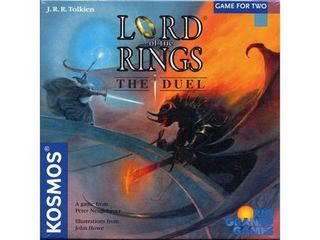
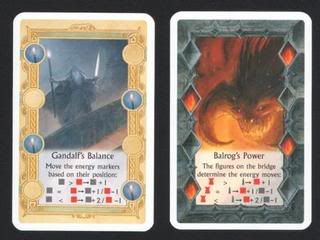
Lord of the Rings: The Duel


Gandalf encounters the Bolrog in the under mountain Caves of Moria. The result is a fantastic duel of their magical powers on a small bridge over a deep chasm.

Hey cool, a magic duel. It's a two player game. It has a nifty 3-D bridge. It's one of the most exciting scenes of the books. It's got Gandalf. It's gonna be great! Well, it isn't great, but it doesn't suck. The Duel is essentially a card game. The 3-D board is just a fancy way to keep score, you don't actually play on it. You could play the game without the board, if the scoring was a little less quirky.

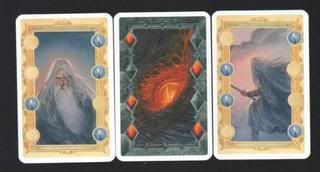
The battle resolution is actually somewhat interesting. Each player receives their own deck of cards. Along the right and left sides of the battle cards are four spaces, some of which contain a "magic symbol," some of which are blank. The right side of the card is the attack. The left side is the defense. Players alternate laying down cards next to the card previously played by their opponent. A spot where there is a symbol on both the attacker's and the defender's card is a successful block. A spot where the attacker has a symbol and the defender doesn't is a hit.

Above you see that Gandalf makes a three dot attack. The Balrog defends with three diamonds, blocking two of Gandalf's dots, and taking one hit. The Balrog makes a two diamond attack. Gandalf blocks one and takes one hit.

You play four rounds of 18 cards. After each round you determine how many steps you get to move up or down on the bridge. Who ever is on the highest step at the end of the game wins. About half way through the second round, I forgot that I was in the middle of a "magic duel" - a battle of life and death between a great wizard and a terrifying monster. I was sitting in silence, staring at my hand as I played an abstract game of match the dots...

I take it back. This game does suck. I want that m****r f*****g Bolrog to burn. I want to throw his ass off that bridge. I want the catharsis of Gandalf triumphing, and to finally get over the trauma of the first time my father read "He staggered and fell, grasped vainly at the stone, and slid into the abyss.' Fly, you fools!' he cried, and was gone."

So, cool bridge, interesting battle mechanic, but ultimately a dry, abstract disappointment.


Harry Potter Trading Card Game

Welcome to Hogwarts! With the Harry Potter trading card game, you join the other new wizards at school in a duel. Then you summon creatures, use magical potions and cast spells to make their cards disappear first. If you do that, you win.

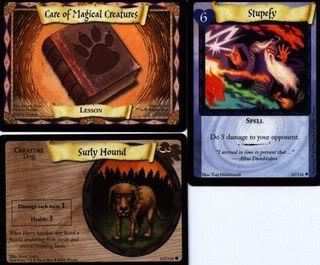
Looks cute. The kids around here spend a great deal of free time dressed in their Hogwarts Halloween costumes, speaking pseudo latin and waving sticks at things. Here's a way for them to play without putting someone's eye out. So I pulled out a couple of decks and played a round with one of the kids. It's been called "baby" Magic the Gathering. You build your own deck, which is made up of Lessons, Spells, Items and Creature cards.


You must have a certain number of lesson cards in play to play spells and summon creatures. The creatures do damage to your opponent, the spells can either do damage or help you in one way or another. You get the idea. It's fairly simple, it's a kid's game, but I'll be damned if it wasn't a hell of a lot of fun. We were summoning snakes and unicorns, casting spells, and yelling "Incendio" and "Stupefy" at each other. I didn't want to give up my deck to the kid who was waiting to play. A couple of adults came to watch and wanted their turn to play. I'm going to have to sit down and make up a few more decks.

Notice I didn't explain the game by saying you play cards with a numeric value whose suits match the suit of the lesson cards in play. These cards subtract the number of points indicated on the card, from your opponent. No, I said that we summoned creatures and cast spells, because that is what it felt like. The theme and the game play were tight.

So, Harry Potter TCG - fast playing fun with lots of flavor.


Here we have two games, that, when deconstructed down to their most abstract form, are quite similar . Each player has their own deck of cards. You play cards which subtract points from your opponent, or prevent your opponent from subtracting points from you. Why did one bore me, while the other amused me? A year ago, I wouldn't have thought too hard about it. My assessment of the two games would have been The Duel = bored now, put nasty game at bottom of game chest. Harry Patter TCG = spell-casting-goodness, put in pretty box on shelf. Beer now.

However, that was before F:AT. As I have said before, for me the most important contribution of the on going discussion of AT games is not the classification of games, but the introduction, and legitimization of new rulers by which to measure games. So I pulled out what I have now identified as my most important ruler : the ability to create narrative. Harry Potter measures up, The Duel not so much. Why? Really, the games are so similar. It's all just addition and subtraction. It would be easy to reduce the Harry Potter cards down to dots and symbols like the Duel cards... but ...they're not symbols. The Harry Potter cards have text. They have FLAVOR TEXT. There are no dots, and arrows and symbols. These cards are not language independent.

I almost called language independence, flavor text's evil twin, but that's not really fair. Language independence has many fine qualities; however I'll leave the lecture on the economics of game publishing and the purity of abstract puzzle solving to Professor Euro.
Evil language independent hieroglyphics. What the hell does this shit mean?

When I open a box for the first time and see those hieroglyphics, I groan inside. Now I have to learn a whole new language of pragmatic symbols, and none of them will translate into anything exciting or poetic or funny. In a language independent game there will be no heroic leaps, or fire balls, no "Horror at Groundbreaking" not even any "Go directly to jail." Instead people will be saying things like, "I'm going to shovel a circle," and "Any one got feet, we need feet?" I'll have to ask to see the rule book again to look up exactly what all the little arrows and pictures of Vienna Sausages mean, which pretty much negates any sense of immersion in theme.

However, when I open a box and see cards with lots of text, especially completely superfluous text in italics, I sigh with contentment. The designer wants to create narrative, and has provided the text for us. We just have to fill in the gaps with our choices and sometimes a die roll or two. It is so much more amusing to summon a Surly Hound, or transform a Raven into a Writing desk, than it is to play 3 dots against your opponent. Maybe, instead of banishing The Duel to the bottom of the game chest, I'll deface the cards with the names or appropriate spells and maneuvers. I have a friend who is a writer and has really good penmanship.

I know that many players ignores the flavor text in their rush to speed up the game. What's the hurry? I suspect these people say things like "I pick yellow," rather than "Mr. Fantastic transforms into a big bouncing ball." I'm certain that they never jump up on their chair, point at you menacingly and shout "Incendio," before slapping their card on the table.

Friday, 13 July 2007

Stock Car Champoinship Racing Card Game. Long name for a pretty cool game.


You all should know I am a race game Junkie. I have this unexplainable attraction to any racing game. From Speed Circuit to Mississippi Queen from Win place & Show to Daytona 500 (one of the best out there), I will pretty much buy any racing game I can get my hands on. Sure these are not your mainstream Ameritrash Fare, but they sure are fun and the good ones do have a lot of player interaction, a ton of trash talking, most have some dice tossing and even the rare combat phase if you look hard enough. (Circus Maximus anyone?) In fact there are few racing games I have played that I didn't enjoy, the only one I can think of is Ave Caesar, that thats really a euro with a racing theme.

So anyway, I have been working with the group to try and run a race season over the next year, and have been looking for a game to do it with. I looked at Formula De, obvious choice in that there are tons of tracks, the game looks great on the table and most folks like it. I however find it a bit the same all the time, a little too easy to be an idiot and wreck someone else and way to much depended on the dice. Speed Circuit was another choice, not as popular with my group as Formula De, and we would have to print out the tracks, turning the members attracted to the bling off, but to me its a much better game than Formula De, using the modified AH rules currently deployed at the WBC. However I do not think I can rally the boys on this one so maybe I keep it in the back pocket for the 2nd season.

The last game that I own and one of my favorite race games is McGartin Motorsport Design's Stock Car Championship Racing Card game. This sometimes hard to find game (it ebays for a ton, but is available most years at the WBC from the designer) is one of the most unusual racing simulations you will find. Instead of a printed track that you move mini cars around. The game attempts to simulate NASCAR races, where the track is almost an afterthought and the action is based around how the lead pack of cars bump and grind for position. SCC, or "that card game" as it has become known in these parts, is far more abstract than a normal racing game. Each player is represented by a car (we use 1/64 or 1/24 die cast mini's) placed on the table in a line. Something like this:

Players have a deck of cards that they draw a hand from (7 to 9 cards depending on the type track). These cards contain a number of different bits of information. Each has a Lap count, a Speed Rating, a Pit Time and an event (Action or Response). there is also a Track Deck that contains cards with events and lap counts on them.

Each turn has 3 phases:

The Track Phase - The top card of the Track Deck is flipped and players must play cards out of their hand so that the added value of these cards meets or exceeds the lap count. Each card played will use up one of the players actions (more later on these) and players can use as many cards as they have actions to fill this, however the more cards played here they less that player can do on his/her turn. Additionally a player may play a draft card here regardless of the lap count on the draft card. This counts as the player making the lap count for the turn but the player will get to take no actions during the turn. Any player unable to make a lap count runs out of gas and fetches beer until the race ends.

Also in the Track deck are events. Like a crash ahead, slow traffic, or engine trouble. Players may have to play a card from their hand or top-deck a random card to see if they get nailed by the event.

The Action Phase - This is where all the fun stuff happens. Players compare the speed ratings on the card(s) played to make the lap count. (if more than on card is used players pick the speed rating they want to use and place it on top of the other cards before seeing other players speed ratings)

Players now can play action cards out of their hand, assuming they didn't use up all their actions making the lap count. (Actions for the games are either 3, 4, or 5 per turn depending on the type of track)

These are usually cards that allow you to pass the guy in front of you, or maybe pull away or even have you pull next to some slower traffic to prevent being passed. This doesn't just happen, that driver in front of you gets the chance to play any response card in their hand. This is usually either a block, or a challenge to your pass. Also there are times when players can choose to draft you while passing, or draft the car being passed, this adds a bonus to the card being drafted for challenges and can cause a lot of heated discussion about potential future support. Anyway this is when race position changes, gaps form etc. etc.

The Refill Phase - This is where player refill their hands (again 3, 4 or 5 cards depending on the track type) Players have a max hand size and can not draw more than the refill limit. Spend too many response cards trying to stay in 1st and you will be playing the next hand a bit short!

Thats a fair description of the basic game. There are advanced rules that limit the size of your draw pile until you pit to refill it, allow you to take damage or use tire points until you pit to fix/replace them.

For a fairly simple card game SCC does a great job at simulating the lead draft in a stock car race. Knowing when to pit under green conditions, timing the drive to the front of the pack, and sometimes getting a lucky caution just when you need to catch up is all a part of the game.

For the season you can score each player using the normal NASCAR points system for finishing and laps on the lead. There is even a driver experience system that can be used to increase hand size, speed modifiers on passing or the drivers skill rating for avoiding random events.

I hope to nail down the rules we will use for our season this week and present it to the group in 2 weeks (I will be in Atlanta next week for some gaming with my F:AT buddies! So look for some crazy session reports soon!)

Thats all for now, and remember "If you ain't first, your last!"

-M

Friday, 4 May 2007

Crusader Rex, (Try it again for the First Time)


The other night at the weekly Wednesday night game event, I had the chance to play a game that was hot for me a while back but had died off a bit lately. The last time I played Crusader Rex was this past summer at the World Boardgaming Championships where Bobby Tweaks laid the smack down on me with some amazing dice tossing skills. Seriously, the game lasted like 30 min, he was hitting 7 out of 8 shots when needing 1's. The world had waited 2000 years for miracles such as these. In short it was a total ass kicking.

Anyway I put the game away after that, not due to the loss, more due to my having the attention span of a retarded gnat when it comes to games. So when Mr. Tweaks phones me up yesterday afternoon and asks if I am interested in playing a block game at the game night, Crusader Rex seem like a fresh choice.

Now, I don't know if any of you have followed this game from the beginning, but I think it is safe to say that the original game was not the best fresh "out of the box." The rules have been through many changes over the subsequent years, some minor clarifications, other (knights Charge) big changes.

Initially my experience with the game (and I was not an early adopter here) was mixed. I really liked it, but could see how it was clearly unbalanced in favor of the Saracens. Many of the earlier rules fixes have not completely corrected this, but the new 1.4 rules were about to be released. The game we played last summer was the first time we had a chance to try out the 1.4 rules (I think these are still current). Too bad it was such a poor showing on my part because we totally missed having a chance to truly test them. Last night we had that chance.

Before I run ahead of myself, I guess I should explain a bit about the game. Wait... why bother I'll just point you to BGG where you can read the reviews that cover the game mechanics. Click here.

So anyway, last nights game was interesting. It had been a while so I can not say it was the best executed game of Crusader Rex ever played. I know I as the Saracens, made some huge mistakes. We played the full game (it takes about 3 hours) and the whole thing came down to the very last battle. A huge tactical mistake by Bobby T and some top notch dice skills by yours truly pulled out a win for Malloc in the end, but it was one heck of a wild ride.

Even though the Saracens won yet again the game felt a lot more balanced to me. The Franks had many chances to win and if they had done some more to keep blocks from going back into the draw pool the crusaders may have arrived a lot sooner than the last turn.

So I have been rambling on for a while now but I have not mentioned what it is I like about this game. To start the theme (IMHO) is great. The Crusades were a strange, interesting, and often misunderstood bit of history. I really like the look of the game and the Art on the blocks is both functional and cool. The rules take a bit of playing before they click but I think 1.4 has cleared up some of the problems around combat found in earlier version.

Game play is similar to Hammer of the Scots, but a lot more tactical. Also the combat is a bit more detailed. The defenders have the option of falling back into a castle to increase the number of hits they can take. The attackers can storm or siege that castle. Also, the Saracens and a few Franks units can harry, retreat while shooting and the Franks can Knights charge, a risky move where 2x the number of dice are tossed but 6's inflict a self wound. This leads to some interesting choices during the battle and sometimes to huge upsets when a Knight's charge goes either really well or catastrophically wrong. The latest rules make it so that the Saracens have to move in, Take ground and fall back with their better blocks to heal. For the Franks its all about weathering the storm until the Crusaders arrive from Europe. These guys are total bad asses that can swing the game in a new direction just by showing up.

Each side plays very differently. Tactics that work for one side are not possible with the other. This goes a long way in keeping the game fresh, just when I think I have mastered the Saracens I play the Franks a few times and have to start all over.

So if you are looking for a medium weight combat game for 2 players, I strongly suggest you check out Crusader Rex. Personally I feel it is the best of the Columbia Block games. Succeeding in a lot of areas that HotS and Liberty fall down. It's not the quickest game but you can, with experience, get it done in under 3 hours. So check it out and have a good time letting the dice fly.

-M

Friday, 27 April 2007

Buffy: "We fight monsters, this is what we do."

I spent last week fraternizing with the enemy . . . literally. I was staying with my brother, who is the second best Caylus player in the world (at least according to WBC). He also won the EuroQuest Caylus tournament, but it is more fun to call him the second best Caylus player in the world because it annoys him.

Anyway, we're pounding some crabs and Natty Bo, and the flesh is flying, which brings up the topic of Buffy the Vampire Slayer, which leads to discussing Buffy the Vampire Slayer the Game. My sister-in-law, who is mostly a party gamer, gets interested and suddenly turns to my brother and says, "I want to play the Buffy game."

My brother just about swallows his tongue. He sputters, "You wouldn't like it."

Feh! For shame! He says this to a woman who was just about the best Mina Harker I've ever played with. So I have a date to teach the Buffy game to my sister-in-law this summer. The way I get my sister-in-law to play with me is . . . well . . . frankly, I lie like a rug.

Last summer I set up Fury of Dracula. Sis walks in.

I just hand her the Mina mini and say, "Your playing Mina."

She looks bewildered for a moment, but before she can say that she can't play because she is on the way to the Outlet Mall, I tell her, "It's really easy. It's a cooperative game. You play on a team like in Wits and Wagers. Your on the same team as the second best Caylus player in the world. Just do what he tells you until you catch on. The object of the game is to figure out where Dracula is hiding, kind of like you do in Clue. You just move one space per turn and then pick cards, like in Pictionary, except the game is about Dracula. You get to be Mina, the hot chick that Dracula bites."

Sis shrugs and says okay. A couple of turns into the game, she is on her feet telling all the boys to shut up because she has a good card to play, which she did. Half way through the game she wants to know why she has to fetch cards and never gets to fight anything.

I told her that Buffy the Vampire Slayer the Game is like Fury Dracula, but not the hunting part, just the fighting part. It takes place in a city after you have already located the Vampire. You just roll to move. Get next to the Vampire and kick him in the head. Easy. Also the two best hunters are the women, Buffy and Willow, so the boys have to be the ones who run around the board and fetch cards for you. That's when she said she wanted to play.

I won't lie to you all though. Buffy the Vampire Slayer the Game is a compact dungeon crawl that plays in 45 - 90 minutes. It has a fresh, modern feel. There's no geeky elves and orcs, or ugly space marines. The heroes are modern humans, the strongest of which is an attractive, fully clothed young woman with normal sized boobies. This might sound stupid to the guys, but I swear, whenever I try to get female friends to play Runebound with me, they take one look at the female character cards and I get a lecture on exploitation and distorted body image and anorexia and the whole world is going to hell in hand basket because they let 8 year olds wear halter tops to school, and OMG Bratz dolls. And I'm like crap, it's a game. You can use a meeple if it makes you feel better. But it's too late, and we end up playing something with a robber, or obelisks or trains instead.

Where was I? Oh yeah, Buffy-dungeon crawl. The problem that I have with dungeon crawls is that they start out exciting, but about half way through they bog down and become dull and repetitive. Then there is the final excitement at the very end. Buffy has two mechanisms that keeps the game moving and changing. First, at the the beginning of the game four artifact cards are placed at the four corners of the board. One of these will make the forces of Evil obscenely powerful if the Evil player can get it and deliver it to the right character. The other three are also pretty spiffy. The beginning of the game, is therefore, more of a race than a simple slugfest. Get your characters to the artifacts, without getting them killed. By the way, getting killed is something that really happens in this game. Healing is very difficult. And when a character is dead, they are pretty much dead for the rest of the game.

The other interesting bit of the game is the phase chart. Some of the faces of the movement dice have a moon on them. If this symbol is rolled, a token is advanced on a circular path that depicts the various phases of the moon, as well as one sun symbol. If the token is on a New Moon, the Evil player has advantage. If the token is on the sun, vampires can not be outdoors. Any vampires that are caught outside when the sunrises take damage and have to run for cover. Finally, during the full moon, the character's that are werewolves transform and become super powerful and super fast. How strong you are, who's up and who's down can change at any moment.

The result of these two mechanisms, as well as the balances and imbalances between the two sides, results in a game that is more cat and mouse than the average dungeon crawl. It is about maneuvering and timing, rather than running out, guns blazing to meet the opponent head on. It's more like, wait for the right moment. Race in. Bitch slap the enemy and then run like hell. There are always tough choices, and all of them have risks. You constantly feel that you are are on the edge of losing, but that victory is almost within your grasp. Also it is just fun kick vampires in the head, or take a bite out of someone.

Finally, if you enjoy Buffy the Vampire Slayer the TV show, this game captures it's flavor and spirit. It's one of those games that when it is over, you remember the story you created by playing.

Menu suggestion: Bloody Marys

Friday, 6 April 2007

Something new... I will talk about a game.

I will attempt to move the topic of things here on the Fortress back to the reason we are all here in the first place. That's right, believe it or not this blog entry will not speak of enemies of mine, or why Caylus sucks or any of that other shit that we tend to get bogged down with too often. I am going to talk (or is that type) about a game I enjoy more than the average collection of cardboard and plastic.

This game is the venerable Avalon Hill Gangsters.

Everything about this game drips with theme. You take on the role of a Gangster (Duh!) in Chicago durning Prohibition. You have 3 playing pieces that you control, one group of Racketeers, a gang of Thugs, and the ever powerful Vamp. The game is played on a street map with a large number of different colored Joints located all over the place. There are three paths to victory, Cash (earn $10,000) , a Monopoly on any single color of Joints, or ownership of 10 different colored Joints.

You start the game with ownership of 3 joints, and a small band of criminals consisting of at least one Racketeer, at least one Thug and a Vamp. You can beef up the number of Racketeers and Thugs you control. These are all represented by one counter, so think of it as increasing their strength. Each unit has a special function.

Racketeers control the number of actions you get per turn. The number of Racketeers you have divided by 2 is the number of actions you can take on a turn. Racketeers are also used to gain control of (buy) Joints. These guys can also perform a hit on another players joint or gang members but they hit only on a 6 so you have to be careful. Since these guys are the brains of the operation they can put business before pleasure and take out a Vamp.

Thugs, these guys are just that, Thugs! They can be used to extort money in unowned buildings, or they can be used to do a hit on an enemy joint, Thugs, or Racketeers. They hit on 5 or 6 so they are better at this than the Racketeers. Their weakness is they cannot bring themselves to shoot up a hot babe, and so they can not take out a Vamp.

Vamps, your ladies, the Ho's. That's right you are a pimp in this game too! The Vamp can be used to "Earn" money in an unoccupied joint. They also are the only member of your gang that can enter a space with an enemy gang member and not have a shootout. In fact if you enter a space containing a rival Thug, or Racketeer, your ladies convince them to join your gang. (That's a might fine woman that can make a man change Religion!) The opposing player loses one Thug/Rack and you gain that Thug/Rack. This is extremely useful for lowering the number of actions the other players get on a turn.

In addition to your own gang, there are other folks running about on the board.

Cops, that's right the boys in blue are here and they intend to mess up a good Gangsters day. Cops are controlled by all players and can bust any player that is performing and illegal act. (be that extortion or in case of the vamp recruiting.) Thy can also raid a Joint if there is illegal stuff going on in there too.

Public, John Q Public also is in the game. Someone has to pay for all these ladies and that expensive booze. Public game pieces are also moved by all players. Getting one in your Joint earns you cash, but exposes that joint to a raid by the Fuzz.

Also there is the Squirt Gun, every time you successfully do a hit on another player you get to squirt them one time with the gun.

On a typical game turn a player rolls 5 different colored six sided dice. (Green for Racketeers, Black for Thugs, Red for Vamps, White for Public and Blue for the cops.) After you roll you have 2 min to make your moves. When the time is up you are done. For each action available to you (number of Racks/2) you can use one Die to move a game piece. Everyone must move the cops 1's t and this does not count as an action. Then you have the ability to move other units. The number on the die is the distance that unit must move exactly without back tracking. No unit can move twice, but you can use the public die more than once to move 2 different units.

In addition, when it is not your turn, and after another player has rolled the die you are not allowed to talk. If you suggest moves in any way another player can call you on it and it costs you $500.

That is it, a quick summary of how this game plays. What ensues at this point is usually a couple of hours of get AT gaming fun!. You have to balance your play between achieving your chosen path to victory and slowing down the other players. Do a Make an enemy our of the guy to my right by using my Vamp to steak his Racketeers? Do I go for the cash or try to get a 4 joint Red monopoly? There is lots and lots of trash talking in this game, and if you do not like other players messing with your plans then pick something else. Gangsters is all about player interaction, its 100% there and you need to count on using and dealing with it if you want to win.
Everyone who claims to like AT games should at least check this game out. Copies are getting harder to find but they do pop up on ebay from time to time.

As a side note I want to say that for those of you who go to the WBC each year. (And all of you should since its the best damn game con out there!) Gangsters is the best run event there. John Pack does a great job running it and keeping it fun for everyone. There are some Great players there and it is almost as fun just to watch them play as it is to play them.

Thursday, 29 March 2007

Twilight Imperium III SE - How I didn't waste my cash.

Every year for my birthday, I host a game day. Now this in and of itself is no big deal, I often have friends over to play games and most of the time we spend a good chunk of time rolling dice or moving cardboard bits about. The birthday bash is a little different. Instead of the normal lets figure out what to play last minute, as all of our games nights usually are, I get to pick the schedule.

My usual plan is to use this to play the longer, more involved games in my collection that see little play time during the rest of the year. (This is most of my games) In the past this has met with mixed success. Two years ago I tried to play A game of Thrones, I failed. Part of this was my fault, I was not prepared enough to drive this game. I was constantly looking up rules and clarifying things. The other part is that this game sucks, and so combined it was a train wreck.

The following year I was a bit more timid, we played the new version of Conquest of the Empire, with the hacked up Struggle of Empires rules. This went over pretty well with most players liking it and saying they would play again. (we have not) This was a much simpler game and the experience, while good, left me feeling that I didn't try hard enough. (We did play Gangsters after this, so thats a bonus!)

This year, determined not to be a slacker, I went all out. The game was going to be Twilight Imperium III. A game I had owned for more than a year (got it 50% off at Borders clearence) and has resigned to probably never play. The inital press on the game and my bad experience with AGoT had me worried that FFg was going to be similar to Eagle in that I would have to try before I buy, due to the games being half-baked. This was before I saw what was added to the patch.... err expansion. Shattered Empires added all the right stuff to TI3, addressing most of the major complaints about the original and adding in just enough to keep it fresh.

So I picked up a copy ASAP and started learning the game. With my past mistakes as a guide, I knew there were a few things that had to happen before I played. First, I was going to know the rules to this thing inside out. I joined an online game at www.ti3wiki.org and began to learn the ins and outs of this system. Second, I was not going to over do it with the optional rules.
One of the mistakes I made with AGoT was that I included too many options, It slowed the game too much and I lost pace, people got bored and it all went south. Determined to not do the same thing again, I spoke to anyone who would talk to me about the game. I asked what options were the best. I read through session reports and tried to see what players liked and disliked. I talked ro Rober Martin, and he insisted that I use the Age of Empires option. (This turns the objectives up at the start of the game.) Also I knew that the simulated early turns were going to be a must. I wanted to use all of the new cards, so this meant using a house rule on the Bureaucracy card. (We added to Trade Goods to it, thanks again Rob)

Due to the fact that everyone playing was a newbie, I mandated that all were to read the rules or suffer that pain of me galling them a "sucker of a thousand cocks". I compiled a 3 page rules summary, a spreadsheet of all the races, a spreadsheet of the action and political cards, a picture of the mapboard, links to the full rules for both the game and the expansion, and pictures of each players pre-determined race mat and emailed everyone in the game.

We got going at 3pm, and I had set an end time of 8:30pm. I knew we would not finish and informed all the player that this would be the case. The idea was that we were going to see if we could learn the game, and if we liked it we would then be able to play again and cut the play time down. Everyone agreed and we got going. In the end it was a huge success, we extended the playtime until about 10pm and made it through 4 full turns and a part of the 5th (one player was able to get a large lead and so we didnt finish the 5th turn.) A good time was had by all. Not a single player disliked the game and all were willing to have another go at it. A success beyond what I could have hoped for.

So if you want some advice on how to play this game with a bunch of newbies... email Rob Martin :) I will be happy to help as well.

-M

Tuesday, 27 March 2007

Thoughts on Marvel Heroes

Superheroes have been the recipient of various board game and roleplaying game efforts over the years--some good, many awful, most of them completely forgettable.

One thing many of them share in common is the "Run downtown to beat up the bad guys!" syndrome. Think about it; in Heroclix, you have two sides setting up for battle, and they essentially rush out towards the middle and lock horns. Even the old TSR roleplaying treatment of Marvel mostly degenerated into this for us....a typical scenario was, "Doc Ock is downtown, robbing the bank! You heroes start here, and go get him!" The map was plopped down, tokens placed, heroes moved, toward the inevitable battle that awaited..and was, for all intents and purposes, THE entire game. The battle was all, and that's all there was.


When I found out about Marvel Heroes, of course I was naturally excited. What was even more exciting was that it was being developed by the same team (Marco Maggi, Francesco Nepitello, Roberto Di Meglio) that developed the phenomenal War of the Ring, easily one of my favorite games of all time and by far one of the best treatments of the Tolkien saga that has ever seen manufacture.


Admittedly, I was initially concerned when I first saw the board and read up on development of the title. The board was obviously abstract; and what do you mean this isn't a skirmish-level treatment of battles between my favorite superheroes?


Turns out, I needn't have worried. Once again, the team has nailed it--though it isn't a perfect game by any means, it is a solid, unique treatment of the superhero game and blends nicely the Ameritrash idea of gameplay with enough Euro elements to bring us a great entry into that growing buzzword of game development--"The Hybrid".


Components


It's a well-known fact: I'm a bits whore. Not to the degree where I'll buy a game blindly for nice bits (if that were the case, I'd no doubt have a copy of Sid Meier's Civilization by now), but there is no denying that I prefer my games to have quality bits.

The game comes with twenty beautifully detailed figures. To be honest I was expecting the pre-painted figures to be this good but they are top-notch. They could use a bit more detailing, but that can be left up to the more enterprising painters among us--of which I am most definitely not one.

You also recieve some custom dice, a nice-sized board of Manhattan, tons of villian, hero, and story cards, and thick cardboard tiles for depicting wounds, trouble markers, and other needed game indicators.

I had read that the bases of the heroes are packed in the box a little snugly, and I will warn you that this is indeed true. It's not a big complaint--just be careful the very first time you remove them. If they prove cumbersome, you can simply bag 'em and put them back in the box--there is plenty of room to store them this way, so you never have to worry about that again.

All in all, the components are high-quality and exactly what you'd expect from Fantasy Flight Games.


Gameplay

Each player chooses from one of four of the most popular teams in the Marvel pantheon--The X-Men, Fantastic Four, The Avengers, and Mavel Knights. The game depicts not one battle between heroes and villians but rather a sort of "campaign", if you will, of heroes attempting to fight various crimes and deal with villains throughout the city. Using an action point system very much like many Euros, you attempt to maximize your actions to score the most points.

Certain heroes are better at dealing with some types of crimes than others, some heroes are better served in a Support role, and some are your obvious bruisers who will gladly go out and seek a fight.

Juggling your resources adds a nice level of strategy to the game, as you will not have enough points to always do what you want to do. On top of this, because you alternate actions with your opponent(s), you have to make sure that you don't get your desired scoring opportunities stolen from you.

Each turn, new "Headlines" are added to the board, and these correspond to the different areas of the board. Some are low-level crimes with low "Trouble Levels" but also have very low point rewards. Others are obviously major crimes (such as a poison cloud being unleashed on the city) and have much higher Trouble Levels.

Trouble Levels are the capital that the other players will have to use against you as you attempt to troubleshoot and score the various crimes. Each player has a separate hand of villain cards that they may play to stop your heroes from achieving their goals. This uses the familiar mechanic of other players playing the "bad guys" during your turn to slow you down rather than direct interference from the other heroes. I agree with this mechanic because while heroes do come to blows from time to time in the comics--most notably Captain America and Iron Man during Marvel's crossover "Civil War"--the focus should be on heroes versus villains, and it is here.

At any rate, villains cost Trouble points to play, so the higher the Trouble Level, the stronger the villian that might be played. Low-level guys like Bullseye cost a measly 1 point, but the heavy-hitters like Juggernaut are going to cost a lot more--but be capable of more damage.

Villains also serve dual purposes--each villain card has a secondary effect that can be used during battle to help the primary villain. Once the villains and his helper cards have been played, we get down to an old-fashioned Ameritrash dicefest, but with a nice twist. Each hero and villain have up to three color-coded powers that they can use during a round of combat. During combat, one player is considered to have the initiative, and will attack first. Hits are counted (and additional dice rolled based on whether you have "Boosting", a gameplay element covered better in the rules) and then the defender rolls to try to negate these hits. If the attack isn't blocked, the defender suffers a point of damage. If that character or villain has damage equal to his "KO" level, he is defeated--in the case of the villain, he is discarded and the heroes can continue Troubleshooting the headline; in the case of the hero, they are sent home wounded. If that was the last hero available to fight, the Troubleshooting action is a failure, and the villain is either discarded or may be added to the "Most Wanted" track if they have the appropriate icon, to show up later and cause more havoc for the heroes.

After each round of combat, there is an Outwit roll. This roll will inflict an additional point of damage for the loser, and the winner will gain initiative for the next round of combat. So the power you choose for a combat round will be dependant on whether you have the initiative, the strength of the attack you anticipate, and if you expect the round to progress to the Outwit roll (and if that roll is important for you to win).

For example, Thing has an attack that lets you roll 5 dice (a very large attack) but only 2 dice on defense and 1 on Outwit; this is when you expect your opponent to have a glass jaw and go down after this hit. However, he has another attack that is low attack and defense (2 dice each) but a strong Outwit roll of 4 dice. Sometimes the choices are obvious, other times you will need to choose which of your options actually suits you best for this round of combat.


There are other elements to the gameplay going on. One is the "Story Deck", a nice little side item that can allow you to score points by manipulating it. This is an attempt to bring in story-based elements to the game, such as Sue giving birth to Franklin (she is QUITE the trooper to be out there battling up until her very delivery!), but mostly this part of the game is quite abstract. It gives you a little "Oh, cool!" part of the game when something happens that involves your team, but the end result is the same--1 VP. You can also trade these story cards in for Team Power-Ups, giving your team permanent benefits for the rest of the game.


The last part I haven't really talked about are the Mastermind villains, also a very cool part of the game. Each team has a fabled nemesis--for example, Magneto for the X-Men and Dr. Doom for the Fantastic Four. One of your opponents will have control of your team's nemesis. Certain headlines have an icon on them indicating that there is potentially Mastermind involvement in the crime, and if you troubleshoot these headlines you will have to suffer addtional meddling from that Mastermind, including added points for playing villains and even battling the Mastermind themselves in combat. These Masterminds have their own "Master Plan" cards that they can try to play, and if they're successful, they become all the more dangerous.

Though the heroes can evade combat with their nemesis, by doing so they become all the more stronger, and the final Master Plan card each may Mastermind may play will dock the hero player a whopping five points--a *huge* sum when the base scenario only involves playing to 15!


There are other elements that add Marvel flavor, including Ally cards that can tag along to help the teams, and Hero cards that can be played for thematic or dramatic effect. Also, taking a page from the best of Euros, the game has some catch-up to the leader gameplay mechanics, including making the Mastermind of the current point leader into something called the "Archnemesis", allowing that Mastermind to interfere in crimes whether there's a Mastermind Icon or not!


My Thoughts


Marvel Heroes hasn't been as warmly received as I expected. There have been a lot of criticisms as to its abstract nature, and more than one player was disappointed to find out that it wasn't a tactical fighting game between heroes and villains. I think this was a wise--and refreshing--decision, as making another game like that would've put it in the same camp as Heroclix and Hasbro's upcoming Marvel Heroscape game, which cover that exact same ground.

As far as abstraction, I think a level of that is necessary, given that the game is trying to capture a larger scale while keeping playing time reasonable. The game is meant to comprise several issues of a comic, with each "Headline" making up one or two issues of that comic, and the Mastermind's involvement being a larger story arc.

Some felt that the "play to 15" element was bland, reducing the game to a scoring exercise with superhero window-dressing. To some degree, that is true; however, the game ships with several scenario cards that change the victory conditions to some that are more thematic (in "The House of M" scenario, each team will have to deal with Magneto himself in a more powerful form during the endgame, and victory will be decided by who defeats him.) This keeps the game fresh, as you will have to play the game differently based on the specifications of the scenario.


I think the dice-based combat system also keeps the game firmly tied to its Ameritrashy combat roots--you simply cannot have superhero battles without chucking dice! Plus, choosing your powers during each round adds decisions and flavor to each battle.

There is no denying that the Euro influence is showing here, but I think in all the best ways. Juggling heroes, action points, and other resources gives you that "the heroes can't be everywhere at once" feeling, just like the comics. The abstraction of movement is more the result of 'pulling back' from the action, and I think that's acceptable given the scope of the game and what it's trying to accomplish.


The Verdict: Marvel Heroes is a find Euro/AT hybrid featuring some of comic's finest. The production value is high, the gameplay fast (a game should finish in less than two hours), and it scales well from 2-4 players.

I think that the abstraction level is high in some regards, and I cannot disagree that the game could've used with a tad less of it. The Story Track, despite its coolness, is really just additional fluff that you will be "gaming" in order to score points off of rather than feeling like its depicting actual events in the Marvel universe.

It also sits in an uncomfortable spot for a hybrid. The theme is going to be seen as "kiddie" or "geeky", the dice are going to turn off Euro gamers (though I think they are implemented very well in this game), and the abstraction is going to bother theme hounds.


Could it be better? Yeah, I think there are spots where the game stands for a bit of room for improvement, but my overall view of the game is that it's an excellent, fresh take on the superhero boardgame. Marco, Francesco, and Roberto have delivered a strong sophmore effort--a tall order after their incredible first breakthrough offering--and I look forward to seeing more of what these guys do in the future.

It's obvious that they're on to something in terms of developing strong hybrids, that's for sure. Thumbs up for "Marvel Heroes".


Score: 8.0/10.0 (Excellent)